


New Construction Inventory Is Piling Up on the Eastside — What That Means for Your Negotiating Power
Tuesday, September 15, 2026
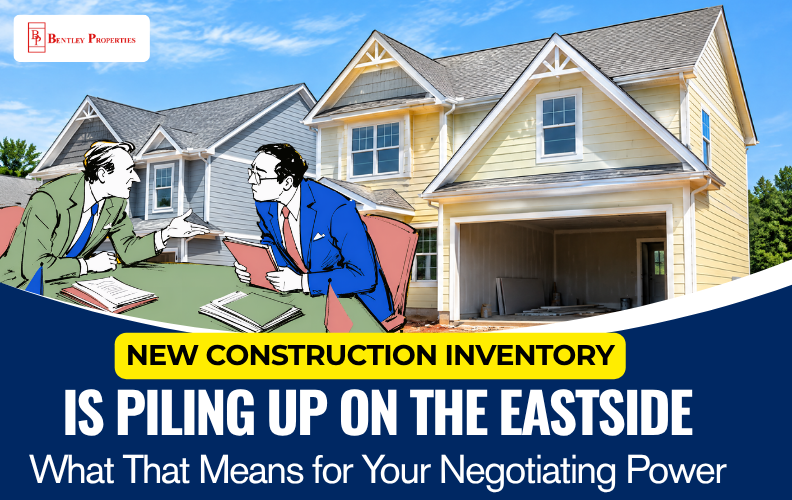 If you’ve been house hunting on the Eastside lately, you may have noticed something that hasn’t been true in years: builders actually have inventory sitting on the market. New construction homes that once sold before the drywall was up are now lingering — and that shift is changing who holds the leverage at the negotiating table.
What’s Actually Happening
Across King County, active listings have climbed to roughly 8,000 homes, with inventory sitting at close to four months of supply — a big jump from the razor-thin, under-one-month conditions we saw during the peak of the pandemic buying frenzy. New construction specifically is running close to five months of supply in parts of the metro area, meaning builders are sitting on finished and near-finished homes longer than they’d like.
Here on the Eastside, that shows up in a very specific way. Builders in Bellevue, Redmond, Kirkland, Issaquah, Sammamish, and Bothell have been shifting toward smaller, more efficient floor plans and attached formats — townhomes and compact single-family designs — to keep monthly payments within reach for buyers who are far more sensitive to interest rates than they were three or four years ago. Even with that adjustment, plenty of builders are still holding completed, move-in-ready inventory that isn’t moving as fast as projected.
Why Builders Are Feeling the Pressure
Builders don’t have the luxury of waiting out a slow market the way an individual seller might. They’re carrying construction loans, paying property taxes on unsold units, and answering to investors who expect a return. Every month a finished home sits empty costs them real money. That pressure is exactly what creates opportunity for buyers.
Rather than simply cutting list prices — which can spook other buyers in the same development and hurt appraisals on homes they’re still trying to sell — builders are getting creative. The most common moves right now:
Rate buydowns. Instead of lowering the price, a builder may pay to reduce your mortgage rate for the first few years of the loan, or even for its full term. On a home in the $1 million range, a well-structured buydown can meaningfully lower your monthly payment.
Closing cost credits. Many builders are covering some or all of a buyer’s closing costs, which can free up cash for the improvements or furnishings you’ll want once you move in.
Design and appliance packages. Upgraded countertops, flooring, or a fully outfitted kitchen that would normally cost extra are increasingly being thrown in at no charge on quick-move-in homes.
Flexible close timelines. Builders with finished inventory are often more willing to work around your schedule, whether that means closing quickly or holding a home while you finish selling your current one.
What This Means for You as a Buyer
The most important thing to understand is that the sticker price on a new construction home is rarely the real starting point for negotiation anymore. Builders would almost always rather offer incentives than reduce their base price, because a lower price sets a public comparable that affects every other home in that community — including the ones they haven’t sold yet.
That means your job isn’t just to ask “can you come down on price?” It’s to compare the total value of the package: purchase price, interest rate, closing costs, and any upgrades, against what you’d pay for a comparable resale home. A $40,000 rate buydown can be worth more to your monthly budget than a $15,000 price reduction, but you’d never know that without running the numbers.
A few practical steps if you’re considering new construction right now:
Get pre-approved before you start touring builder communities. Builders often reserve their best incentives for buyers who use their preferred lender, and knowing your numbers in advance lets you evaluate whether that lender’s offer is actually competitive or whether you’re better off bringing your own financing to the table.
Ask specifically about “quick move-in” or completed spec homes. These are the units costing builders the most to carry, and they’re typically where you’ll find the most room to negotiate — far more than on a home that hasn’t broken ground yet.
Don’t assume the builder’s sales representative is working for you. They represent the builder. Having your own agent review the purchase agreement, walk the comparables, and negotiate on your behalf costs you nothing as the buyer, since the builder typically pays the buyer’s agent commission, and it means someone is looking out for your interests specifically.
What This Means if You’re Selling a Resale Home
If you’re on the seller side right now, rising new construction inventory is worth paying attention to as well. Buyers comparing your home to a builder’s incentive-loaded new construction listing are weighing more than just price — they’re weighing a brand-new roof and systems, builder warranties, and a move-in-ready finish against whatever updates your home may need. That doesn’t mean your home can’t compete; it means pricing strategy and presentation matter more than ever, and it’s worth having a conversation about how your home stacks up against what’s currently available nearby before you list.
Bottom Line
More inventory generally favors buyers, and right now that’s especially true in new construction, where builders have real incentive to make a deal happen. But navigating builder contracts, incentive structures, and construction timelines is genuinely different from a resale transaction, and the fine print matters. Whether you’re weighing a new construction purchase or wondering how your resale listing stacks up against it, I’m happy to walk through your specific situation and what makes sense for your goals.
Reach out anytime to schedule a no-obligation strategy call, and we’ll map out your best next step together.
